
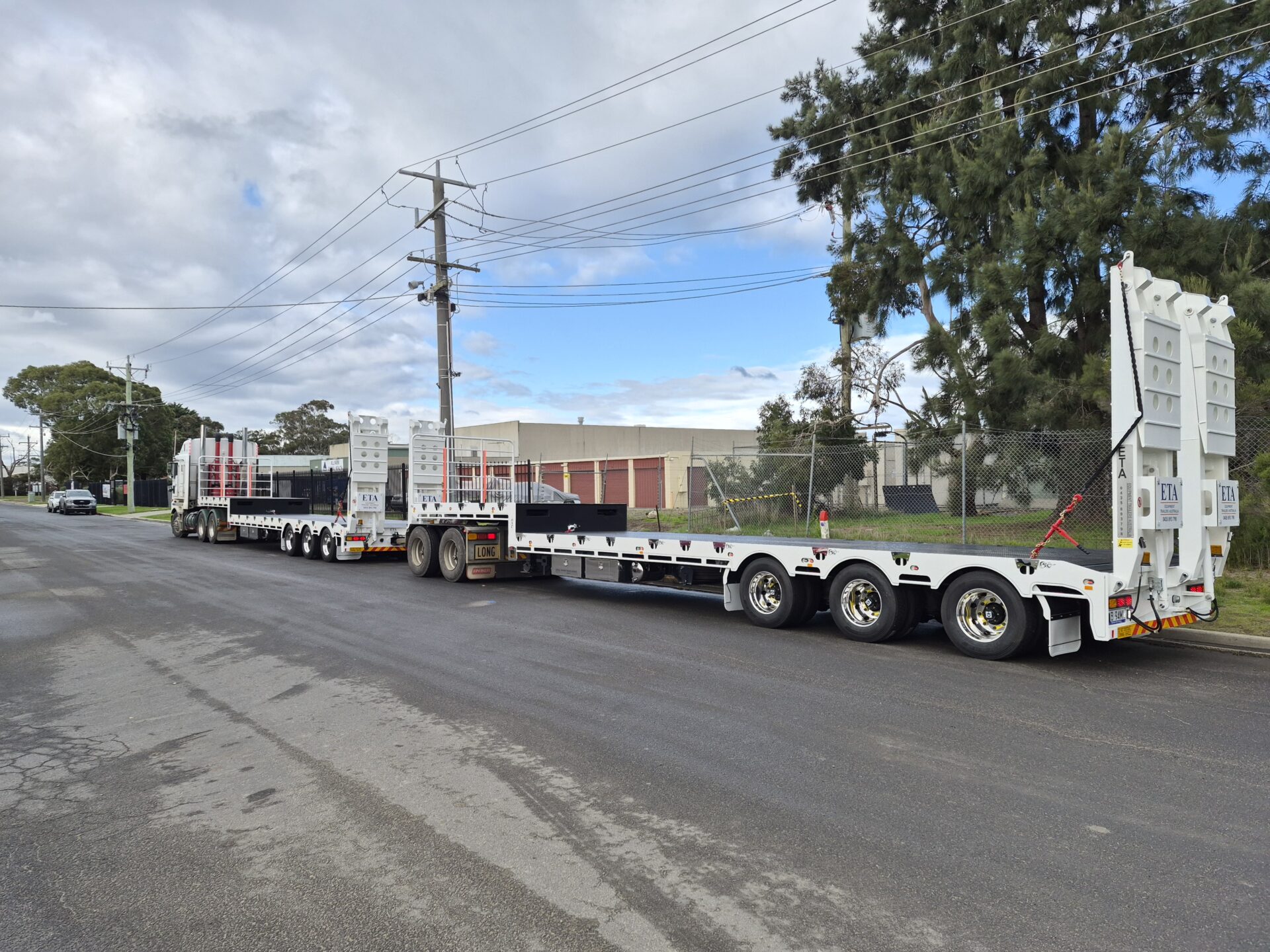
Drop Deck vs Flat Top Trailer: Which Fits the Load?
A drop deck and a flat-top trailer can both carry heavy freight, but they are designed for different transport tasks.
A flat top has one continuous, level deck. It is a practical option for steel, pipe, palletised freight and construction materials. A drop deck has a raised front section and a lower main deck behind it. This lets taller freight or machinery sit lower to the road, which can make a meaningful difference where overall height and loading access are important.
The right choice depends on the load, how it will be loaded, the prime mover it will work with and the routes it needs to travel. Neither configuration is automatically better—the best option is the one that suits the job.
The key difference
The main difference is deck height.
A flat top provides a long, uninterrupted deck from front to rear. It is often well suited to general freight that can be loaded by forklift or crane and does not require reduced deck height.
A drop deck has two deck levels: a higher front section and a lower deck behind it. The lower section can help taller loads sit closer to the road and can provide a more practical arrangement for machinery that needs to be loaded using ramps.
In simple terms:
- Drop decks often suit machinery, rural equipment, hay, palletised freight and general freight where deck height or ramp access is a key consideration.
- Flat tops often suit steel, pipe, pallets, construction materials and longer loads that benefit from a continuous, level deck.
When a drop deck is the better fit
A drop deck is often the practical choice when machinery needs to be driven onto the trailer, or when the height of the loaded freight needs to be kept as low as possible.
Its lower deck can help provide additional clearance for taller machinery and may be especially useful on routes with low bridges, overhead structures or other height restrictions. It can also make loading more workable for certain equipment, although the machine’s weight, ground clearance, approach angle, ramp capacity and site conditions still need to be considered.
Common drop-deck applications include agricultural machinery, plant equipment, hay, grain-season freight, palletised loads and general freight that may sit too high on a standard flat top.
A drop deck does not remove the need to check load height, weight or route restrictions. It simply provides more flexibility where deck height is likely to limit the job.
When a flat top is more practical
A flat top is often the straightforward option for freight that does not need a lower deck.
Its continuous, level surface can make load placement and securement simpler for steel, pipe, palletised goods, construction materials and other general freight. It can also suit loads handled by forklifts, cranes or other lifting equipment.
A flat top may be the more practical choice when a long, uninterrupted deck is more important than reduced load height. However, the total height of the trailer and load still needs to suit the planned route, so dimensions should always be checked before choosing a configuration.
What to check before choosing
The choice between a drop deck and a flat top should be based on the real requirements of the job—not simply the trailer style preferred by the operator.
Before requesting a recommendation or quote, have these details ready:
- Load type: Machinery, steel, pipe, pallets, agricultural equipment, construction materials or another freight type.
- Maximum dimensions: The height, length and width of the load in its transport condition, including attachments that remain fitted.
- Load weight: The heaviest realistic load, including attachments and accessories—not only the average load.
- Loading method: Whether the load is driven up ramps, loaded by forklift, lifted by crane or handled another way.
- Site conditions: Ground surface, loading space, machine approach angle, ground clearance and access at pickup and delivery locations.
- Route: Low bridges, overhead structures, restricted urban access, regional roads, state-border travel and any width, height, weight or length restrictions.
- Prime mover: Fifth-wheel arrangement, relevant ratings and the type of work the complete combination will perform.
These details help determine whether deck height, ramp access, continuous deck space, axle configuration or another feature should drive the specification.
When a standard trailer is not enough
Some jobs need more than a standard drop deck or flat top.
A drop deck widener can provide additional deck width for oversized agricultural equipment, broad machinery and other loads that exceed standard width requirements. An extendable trailer can provide extra length for long equipment, structural materials, site huts, modular buildings and wind-energy components.
For oversized or specialised work, the trailer must still suit the load dimensions, weight, loading method, route and prime mover. Route checks, permits or approvals may also be required before the work begins.
Choose for the work ahead
There is no universal answer to “drop deck or flat top?” A drop deck may be the better fit where machinery needs ramp access or tall freight needs to sit lower. A flat top may be the better option for steel, pipe, pallets, construction materials and other freight that benefits from a continuous deck.
ETA Trailers is the official East Coast distributor for FreightWest Next Gen Trailers. If you are planning a new trailer, talk to our team about the load you carry, the routes you run and the prime mover you use. We can help you identify a practical configuration for the work you do now—and the work ahead.

